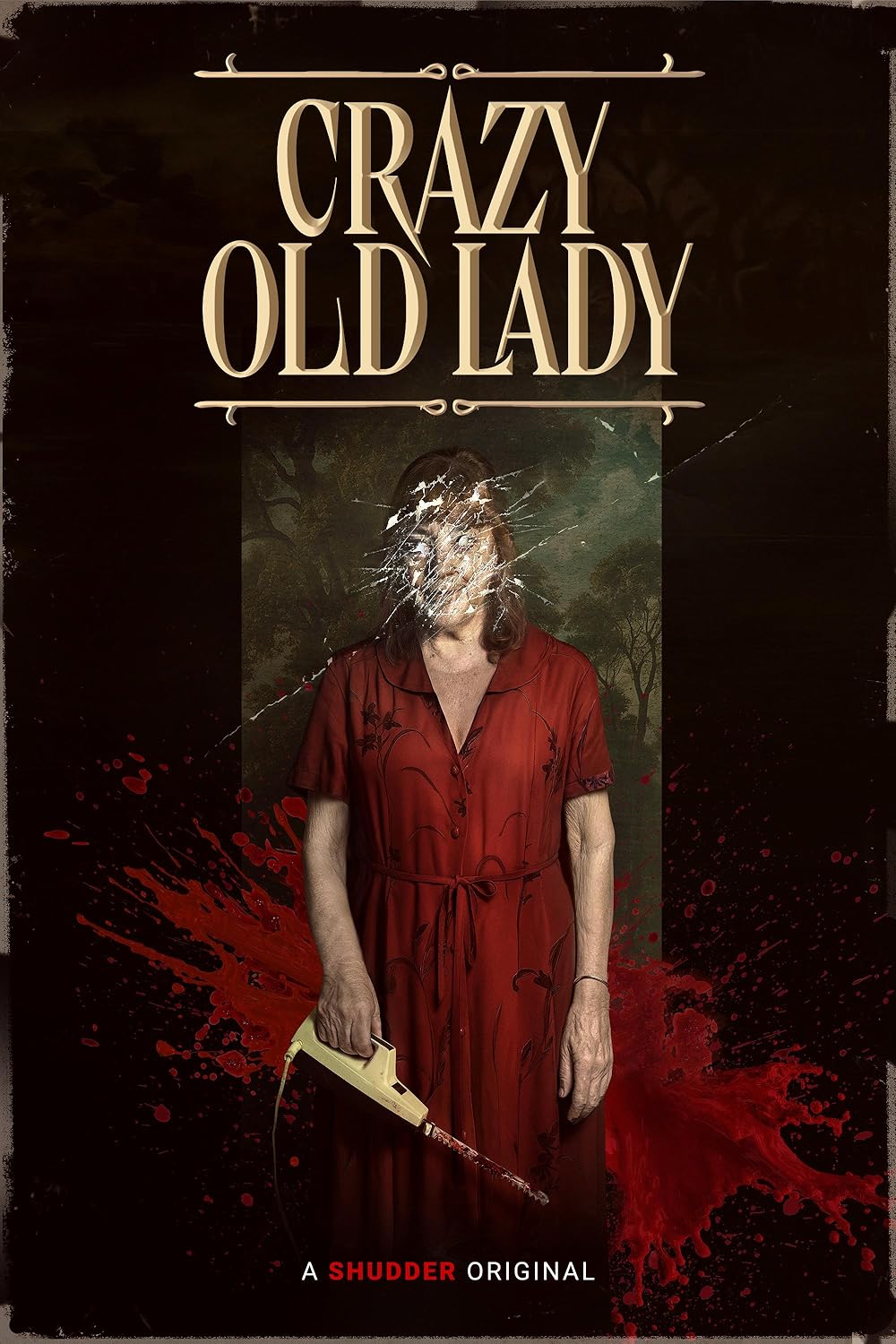
Crazy Old Lady, a new horror film starring acting legend Carmen Maura is now streaming on Shudder. Cherry the Geek TV chatted with Crazy Old Lady writer/director Martin Mauregui about making the film.
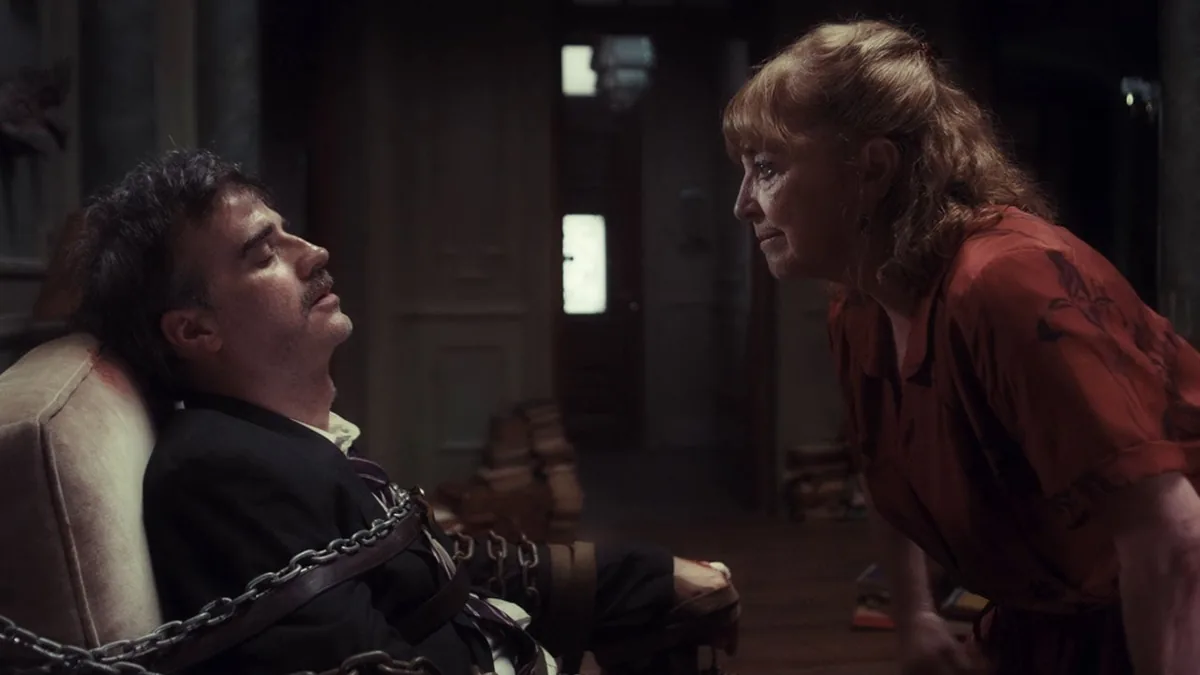
The film takes place on a stormy evening. A man named Pedro, played by Daniel Hendler, receives a desperate call from his ex-girlfriend asking him to look after her senile mother, Alicia. What begins as a simple favor soon turns into a terrifying ordeal when Alicia refuses to let him leave. Trapped in the house, he’s forced to play along with her sadistic games to survive the night.
You’re not just the director of the film, but also the writer. What was the genesis of the film? What made you want to tell this story?
I wanted to tell a small, possible story, to build a production with few actors, in almost a single location, but that was also intense and complex, able to move from comedy to horror. I wanted to explore the sinister that lies beneath the everyday.
A friend once told me an anecdote similar to the first scene of the film: her mother called her while she was driving to talk about a husband she had before her father. In real life, it was just confusion—but I began wondering what if that husband had existed, what if he were the memory of a dark past resurfacing through senile dementia?
You’re working with a legend on this film–Carmen Maura. Tell me about her. What was it like directing her, and how did the character change from what you had on the page and in your mind once she was cast? What did she bring to the role that made her the perfect “Alicia?” Was there a moment on set where she completely transformed a scene with just a look?
Directing her was one of the best things that ever happened to me. I learned so much from her, and not just as a filmmaker. I didn’t have Maura in mind when I wrote the character—I never imagined I’d get to work with someone like her—but when she showed up, it was like an earthquake that leaves everything exactly where it’s supposed to be. She is the perfect Alicia. There were many moments in rehearsals and filming where Maura transformed scenes with a look, a gesture, or a change in tone; but I’ll stick with one: near the end, when Alicia flees the house and shifts, in the same shot, from anguish and confusion to finding solace in a cigarette and the music of Virus.
Talk about the casting of Daniel Hendler. What qualities does he have as an actor that make him the perfect Pedro? How did you work with him to ensure that he wasn’t just a victim, but a scene partner could match Carmen’s intensity beat-for-beat?
Unlike Maura, I always wrote the character of Pedro with Hendler in mind, thinking of his specific blend of humor, pain, suspicion, and vulnerability. Since his character is a victim for almost the entire movie, we had to find a balance between desperation and intelligence so we wouldn’t just have a guy in chains screaming for help the whole time. In rehearsals, we generated a sort of pulse—a contained violence—so that Pedro felt like he was on the verge of exploding at any moment, even though he doesn’t. At the same time, Hendler is very physically expressive, so I thought it was a clever choice to have him play a man who cannot move, allowing that physical energy to be expressed in other ways (though I couldn’t resist the urge to make him dance halfway through the film).
I’m curious about how you go about creating tension for the film, not just in individual scenes, but building it throughout the film as a whole as well. When you are filming individual scenes, is there always something in the back of your mind as you’re directing about how the scene fits into the overall narrative in terms of tension building? Or it something you build in the edit? A combination of both? What’s your process?
I am a screenwriter above all else, and that leads me to approach the material with a lot of planning. The tension of the overall narrative was built starting with the script, but also through a staging process that was assembled and tested long before filming. We wanted to create the feeling of constantly drawing a bow without ever firing the arrow. Later, the editing provides the framework for all of this; it’s where you find the most difficult and important thing in a film: the tone.
There’s a screenwriting tool we also used in the staging, editing, and sound design called the “snowball.” It consists of starting with a small detail—a minor resource, a gesture, a game, a phrase—and developing it in a crescendo, gradually but unstoppably, until the avalanche arrives and sweeps everything away. Individual scenes were built as mirages of calm in the middle of the torment—moments that could even be luminous (the bird)—but which immediately turn back into a threat, returning to the darkness of Alicia’s mind, as if everything happening in that house were an expression of her perverse psyche.
What was the biggest challenge you faced when making the film? And on the opposite end of the spectrum, what was the biggest “pleasant surprise”–something you thought was going to be difficult or a challenge going in, but ended up working out better than expected?
The biggest challenge, as with almost any movie, was getting the money to make it, but that was mostly the producers’ job. In my case, the biggest challenge was perhaps post-production—finally “finding” the movie in the edit, the sound design, and the music, and agreeing with the producers on what the tone should be. On the flip side, I think the “pleasant surprise” was working with an actress of Maura’s stature. She could have been a difficult diva, but she handled herself with sensitivity, intelligence, and empathy. She even asked me not to praise her on set: she would do these spectacular things and I wouldn’t say a word; I’d just look at her and nod.
What was it like working in the horror/thriller genre? What was the experience like? Is it a genre that you would like to continue working in? What do you like about it?
I’ve been dabbling in thrillers and horror as a writer for a while; I find them to be powerful tools. I like the business of generating something akin to the anxiety produced by fear. A few years ago, a Colombian producer told me something revealing: that horror can be a space of “cinematic resistance.” It allows us to break barriers and dig deep into gruesome topics without breaking the bond with the viewer. It’s a space of resistance that lets us poke our heads up for air amidst a sea of franchises, sequels, and remakes. It lets us look for something new, even if we’re using old tools.
What were your horror/thriller influences growing up?
I grew up watching horror movies on VHS. Every time it rained, my friends and I would run to the video store in search of a new scare. Films that mixed humor and horror were important to me, like Evil Dead 2 or House, and characters like Freddy Krueger or the clown from It who could make you laugh in the middle of hell. For Vieja Loca, I looked for references in films that, while not horror, could generate tension or discomfort just through dialogue, as seen in much of Buñuel’s work. In The Exterminating Angel, you have a group of characters who can’t leave a single location; in Viridiana, they are in the same place almost the whole time. Both films develop with an unstoppable crescendo until the avalanche hits. But within horror, if I have to mention the movies that scared me most—those inimitable, unique films—I’d say The Blair Witch Project and, above all, The Exorcist.
You’ve created this incredible sense of claustrophobia in a single location. How do you keep the visual language fresh for an audience so that they feel as trapped as Pedro, but never bored?
We looked to generate “novelty” and “freshness” through the narrative—through the dizzying progression of elements. That “snowball” effect I mentioned earlier. For example, we used Swing & Tilt lenses, which shift the focal plane to create specific out-of-focus areas in the frame. Two things at the same focal distance could have one in focus and the other not, creating an almost subconscious distortion. Beyond the massive effort from art, cinematography, and sound to make the house feel alive and threatening, we built the space with the lenses: early on, we used wide-angle lenses to give a broad dimension of the characters and their surroundings, but we progressively moved toward telephoto lenses to denote that sense of claustrophobia you mentioned—to make the house close in on the characters and envelop them.
Similarly, there are several crescendos in the sound: the rain, the wind, and the storm go through different stages to the point where, at times, the sound team seemed to be conducting an orchestra of storms. The same goes for the costumes: while most characters have a single outfit, Alicia transforms during the story, going through different costumes—from Antigone’s attire to a date dress paired with sneakers stolen from the nurse. These are just a few examples.
The film is grounded in the sobering reality of caretaking for an aging loved one. At what point in the writing process did you realize that the real life anxieties of dementia were actually the perfect foundation for a bone-chilling horror story?
I think from the very beginning. The character of Laura, in that first scene which was the foundation of everything, expresses that terrible anxiety of having a loved one in a vulnerable state. Dementia has that unexpected, disruptive, and violent nature that can turn a loved one into a threat to themselves or others. The responsibility of caregiving, but also the desire to escape that painful situation, is expressed by Laura being on the road, moving away from her mother—escaping, in a way. I also wanted to explore that inherited fear that spans generations, almost like a curse. Children of people with dementia often ask themselves, with dread, if the same thing will happen to them. Seeing a monster in that parent and being afraid of becoming that same monster because you have the same genes, the same blood. Dementia as a metaphor for trauma passed down from generation to generation.
Every great horror film has that one moment where the audience collectively gasps or winces or squints. What is the one shot or line or moment in Crazy Old Lady that you are most excited–or perhaps the most nervous–for a Shudder audience to see for the first time?
The moment with the game to see if Pedro is freed or loses a finger—it excites me at first, and then every time I see it, it makes me very nervous; it gives me a hard time and makes me want to look away. What affects some people doesn’t affect others; several viewers told me VL is a heavy movie, while others found it more comedic and didn’t feel it was so terrible. Other moments I’m excited about are the opening with Laura in the car, the scene with Pedro and the bird, Alicia’s recounting of the past, the dream that connects the grandmother and granddaughter, and the finale with Maura in the car, almost looking at the camera. There is another violent scene that makes me very nervous, mostly because I know what the actors put on the line—the dedication they gave and how much it cost to film—but I prefer not to talk about it and let you imagine which one it is.
What do you hope audiences take away with them after they see the film? What do you want them thinking or talking about?
I would like them to take the characters with them. I’d like the character of Alicia—demented, fierce, and passionate—to stay with the audience for a long time after the credits roll.
Crazy Old Lady is now streaming on Shudder.
About Author